
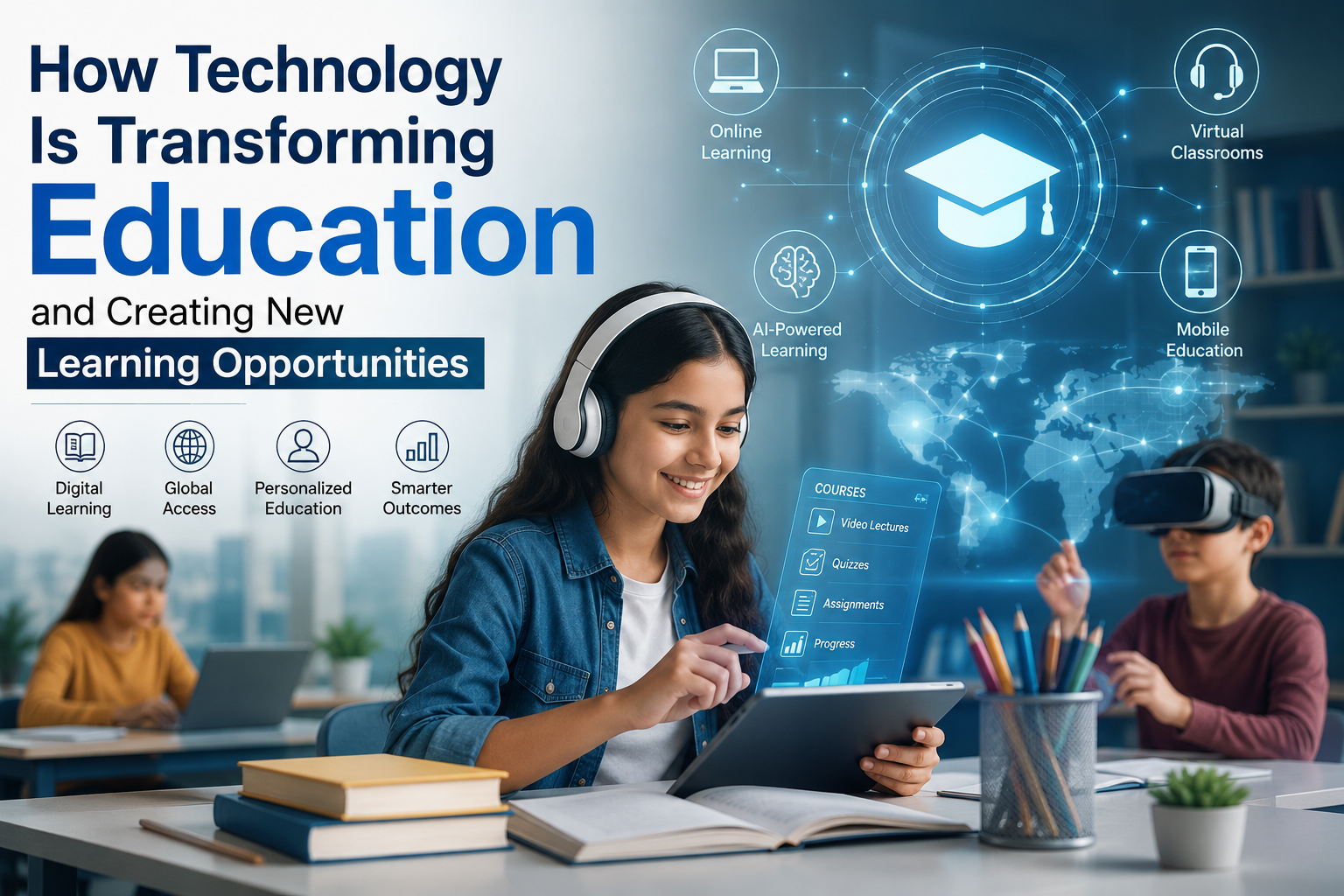
Education has always been one of the most important foundations of personal and social development. It helps people gain knowledge, develop skills, build confidence, and prepare for future opportunities. However, the way people learn has changed significantly over the years. Traditional classrooms and textbooks are now supported by digital platforms, online courses, educational applications, interactive tools, and artificial intelligence.
Technology has made education more accessible, flexible, and engaging. Students can attend classes from almost anywhere, access educational resources within seconds, and learn at a pace that suits their individual needs. Teachers, meanwhile, have access to innovative tools that can make lessons more interactive and help them understand student performance more effectively.
The transformation of education is not simply about replacing books with computers. It is about creating a learning environment where technology supports teachers, encourages students, and opens doors to knowledge that may once have been difficult to access.
The Growing Role of Technology in Education
Technology has become an important part of modern education. Schools, colleges, universities, coaching institutes, and professional training platforms increasingly use digital tools to improve the learning experience.
From online classrooms to digital assignments, technology has introduced new ways of teaching and learning. A student can now watch an educational video, participate in a virtual classroom, complete an online assessment, or explore an interactive learning module without necessarily being present in a physical classroom.
Online Learning Has Made Education More Flexible
One of the biggest changes brought by technology is the growth of online learning. Students are no longer limited to courses available in their local area. They can explore programs offered by educational institutions and learning platforms across different cities and countries.
Online learning is particularly useful for people who have work, family, travel, or other responsibilities. Instead of following only a fixed classroom schedule, learners can often choose when and where they want to study.
Recorded lectures also allow students to revisit difficult topics. If a concept is not understood during the first lesson, learners can watch the explanation again and review the material at their own pace.
Digital Resources Make Learning More Accessible
In traditional education, students often depended heavily on textbooks and classroom notes. Today, digital resources have expanded the amount of information available to learners.
Educational websites, digital libraries, research databases, podcasts, videos, presentations, simulations, and interactive exercises can provide additional explanations and examples.
This variety can be especially helpful because students have different learning preferences. Some understand concepts better through reading, while others may learn more effectively through visual demonstrations or practical activities.
Artificial Intelligence and the Future of Learning
Artificial intelligence is becoming another important part of the education landscape. AI-based tools can support both students and educators by helping with research, practice, personalized learning, and administrative activities.
AI does not have to replace teachers. Instead, it can work as a supporting technology that helps educators spend more time on meaningful interaction with students.
Personalized Learning Experiences
Every student learns differently. Some learners understand a topic quickly, while others need additional practice and explanation.
Technology can help create more personalized learning experiences. Digital platforms can analyze a learner's progress and recommend exercises or resources based on areas that require improvement.
For example, a student struggling with a particular mathematical concept may receive additional practice questions, explanatory videos, or simpler learning materials before moving to more advanced topics.
This approach can make education more learner-centered rather than following exactly the same path for every student.
AI as a Learning Assistant
AI-powered educational tools can help students brainstorm ideas, explain difficult concepts, generate practice questions, summarize study material, and organize learning activities.
However, students must learn how to use such tools responsibly. Technology should support understanding rather than encourage learners to avoid thinking independently.
The most effective approach is to use AI as an assistant while continuing to develop critical thinking, creativity, communication, and problem-solving skills.
Interactive Learning Is Changing Student Engagement
Traditional lectures can sometimes make learning feel passive. Interactive technology has created opportunities for students to participate more actively.
Educational games, quizzes, simulations, virtual experiments, polls, and interactive presentations can make lessons more engaging.
Gamification in Education
Gamification involves using elements commonly found in games, such as points, challenges, levels, rewards, and progress tracking, within learning activities.
The purpose is not simply to make education entertaining. Well-designed gamification can encourage students to practice regularly and remain motivated.
For example, a language-learning application may award points for completing vocabulary exercises. Students can track their progress and set personal learning goals.
Virtual Simulations and Practical Learning
Some subjects require practical experience. Technology can provide simulated environments where students can explore situations that may be difficult, expensive, or unsafe to reproduce in a traditional classroom.
Virtual simulations can be useful in areas such as science, engineering, medicine, business, and technical training.
Students can experiment, make mistakes, observe outcomes, and repeat activities while developing a stronger understanding of theoretical concepts.
The Importance of Digital Skills for Students
As technology becomes more important in professional life, students need more than traditional academic knowledge. Digital literacy is becoming an essential skill.
Students should understand how to use digital platforms, search for reliable information, communicate online, protect their personal information, and evaluate digital content.
Learning to Identify Reliable Information
The internet provides enormous amounts of information, but not everything published online is accurate.
Students need to develop the ability to evaluate sources carefully. They should consider who created the content, whether the information is supported by evidence, when it was published, and whether other reliable sources provide similar information.
This skill is particularly important in an environment where social media and online content can spread information quickly.
Developing Responsible Digital Habits
Digital education should also include responsible technology use.
Students should understand the importance of privacy, strong passwords, respectful online communication, copyright, and safe browsing practices.
Learning how to use technology responsibly can help students become more confident and informed digital citizens.
Technology Is Supporting Teachers Too
The transformation of education is not only benefiting students. Teachers are also gaining access to tools that can simplify their work and improve classroom management.
Digital platforms can help educators prepare presentations, create assessments, organize learning materials, monitor assignments, and communicate with students.
Data Can Help Teachers Understand Student Progress
Learning platforms can provide information about student participation and performance.
Teachers can use this information to identify areas where students are struggling. Instead of waiting until the end of a term to discover learning gaps, educators can potentially address problems earlier.
Technology therefore has the potential to support more informed teaching decisions.
Teachers Remain Central to Education
Despite rapid technological development, teachers continue to play an essential role.
A teacher provides encouragement, emotional support, mentorship, context, discipline, and human interaction. These qualities cannot simply be replaced by software.
Technology can provide information, but teachers help students understand how to apply knowledge in real situations.
The strongest education systems are therefore likely to combine technological innovation with effective human teaching.
Benefits of Technology-Driven Education
The growing use of technology offers several advantages when implemented thoughtfully.
Greater Accessibility
Students who live far from major educational centers can access online learning opportunities that may previously have been unavailable to them.
Flexible Learning
Digital learning allows people to study according to their schedules. This can be particularly valuable for working professionals and students with other responsibilities.
Wider Learning Resources
Students can explore a wide range of educational materials instead of relying on a single textbook or classroom explanation.
Faster Feedback
Online quizzes and digital assessments can provide immediate feedback, allowing learners to identify mistakes and improve more quickly.
More Engaging Lessons
Interactive content, videos, simulations, and educational games can make certain subjects more engaging and easier to understand.
Challenges of Digital Education
Although technology offers many benefits, it also creates challenges that need to be addressed.
The Digital Divide
Not every student has equal access to reliable internet connections, computers, or smartphones.
This digital divide can create educational inequalities if online resources become the only way to access important learning opportunities.
Schools, governments, communities, and technology providers need to work together to improve digital access.
Screen Time and Distractions
Excessive screen time can make it difficult for students to maintain concentration. Digital devices can also create distractions through social media, entertainment, notifications, and unrelated content.
Students need healthy study routines that balance digital learning with offline activities, physical exercise, rest, and face-to-face interaction.
Maintaining Academic Integrity
Digital technology has also created new challenges related to plagiarism and unauthorized assistance.
Educational institutions need to teach students about academic honesty while developing assessment methods that encourage original thinking, practical application, and creativity.
The Future of Education
The future of education is likely to be a combination of traditional teaching and emerging technology.
Classrooms may become increasingly connected, with students using digital tools alongside books, discussions, projects, and practical activities.
Hybrid Learning May Become More Common
Hybrid education combines online and offline learning. Students may attend physical classes for discussions, practical work, and group activities while completing selected lessons or assignments online.
This model can provide flexibility without completely removing the social benefits of physical classrooms.
Skills Will Matter Alongside Degrees
Modern careers are changing rapidly. As a result, students may need to continuously develop new skills throughout their professional lives.
Communication, creativity, critical thinking, teamwork, adaptability, digital literacy, and problem-solving are likely to remain valuable across many industries.
Education will therefore increasingly focus not only on what students know but also on how effectively they can apply their knowledge.
Creating a Balanced Learning Environment
Technology should not be viewed as a complete replacement for traditional education. Instead, it should be considered one part of a broader learning ecosystem.
A balanced educational environment can combine textbooks, classroom discussions, practical activities, digital resources, online courses, collaborative projects, and technology-assisted learning.
Students should have opportunities to learn independently while also developing communication and teamwork skills.
Teachers should receive appropriate training so they can use technology effectively rather than simply adding digital tools without a clear educational purpose.
Parents and educational institutions also have an important role in helping young learners develop healthy digital habits.
Conclusion
Technology is transforming education by making learning more flexible, accessible, interactive, and personalized. Online classrooms, digital resources, artificial intelligence, educational applications, and interactive platforms are creating new possibilities for both students and teachers.
However, technology alone cannot solve every educational challenge. Access, digital literacy, responsible technology use, academic integrity, and human interaction remain important considerations.
The future of education will likely depend on finding the right balance between innovation and traditional teaching principles. Technology can provide powerful tools, but effective education ultimately depends on curiosity, good teaching, meaningful interaction, critical thinking, and a willingness to learn.
As technology continues to evolve, education will continue to change with it. The greatest opportunity lies not simply in adopting new tools, but in using those tools thoughtfully to create learning experiences that prepare people for an increasingly connected and rapidly changing world.